
Equity Spotlight: Roc Summit Private Equity Fund
The Opportunity
The Roc Summit Private Equity Fund gives wholesale investors access to a diversified portfolio of Australian and New Zealand private equity through a single fund. The Fund is managed by Roc Partners, a private markets specialist with more than 25 years of history, around $9.2bn in funds under management, and roots in Macquarie's former private markets division. It invests across every stage of a company's lifecycle (venture, growth, buyout and turnaround) and through every private equity route: secondaries, co-investments, primary fund commitments and opportunistic deals. The thesis rests on Roc's long-standing relationships with leading local managers, including Quadrant, Crescent, Anchorage, Mercury and Next Capital. Those relationships give it access to deal flow and secondary opportunities that are typically out of reach for individual investors.
The Portfolio
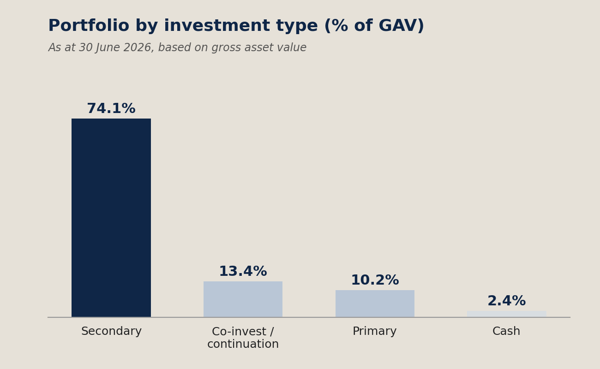
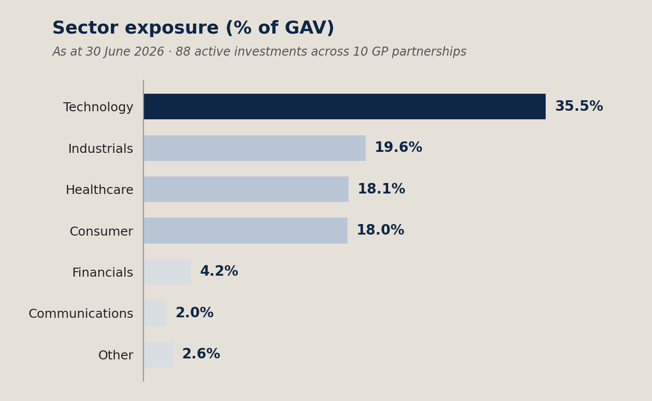
Twelve months after launching on 1 July 2025, the Fund holds $60.2m in net assets across 88 active investments and 10 GP partnerships. The portfolio is weighted towards secondaries and buyouts. Technology, industrials, healthcare and consumer are the largest sector exposures. The top 10 holdings make up 40% of gross assets. The largest are GBST (wealth management registries, 7.9%), Airwallex (global payments, 6.2%), Timezone (family entertainment, 5.4%) and Rokt (AI-powered e-commerce adtech, 5.3%). Recent co-investments include efex, AWCON, Aidoc and Q-CTRL, and six further ANZ deals are in the pipeline for August to November 2026.
Expected Returns
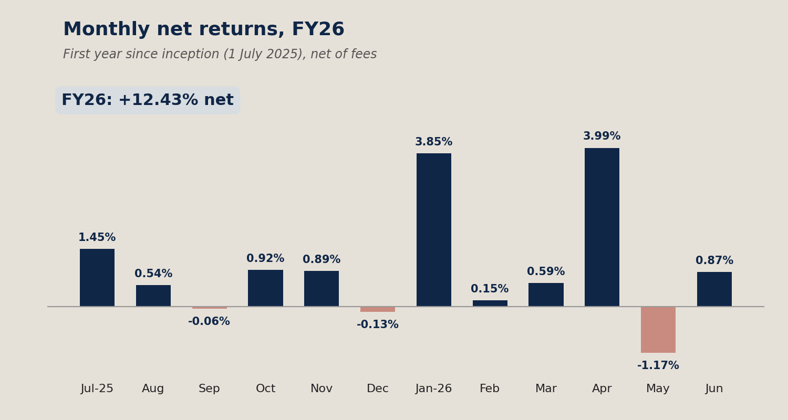
The Fund returned 12.43% net of fees in its first financial year, within its 12–15% p.a. target, with nine of twelve months positive. June delivered +0.87%, driven by uplifts in RAST 2025 and Square Peg Opportunities Fund 3, and Airwallex completed a US$11 billion funding round. An annual distribution of $0.0401 per unit was paid, mostly from realised capital gains. Further near-term distributions are expected from ClearView (Zurich take-private), Imaging Associates (continuation vehicle), Amart (potential IPO) and Hall Contracting (sale process). The Fund is open to wholesale investors only, with a minimum investment of A$100,000. Fees are a 1.7% p.a. management fee plus a 10% performance fee over an 8% hurdle on secondaries, co-investments and opportunistic investments. Redemptions open after a lock-up of up to two years and are capped at 5% per quarter, so this is best treated as a long-term allocation. Past performance is not a reliable indicator of future performance.
Property Spotlight: LDR Grey Street Fund
The Opportunity
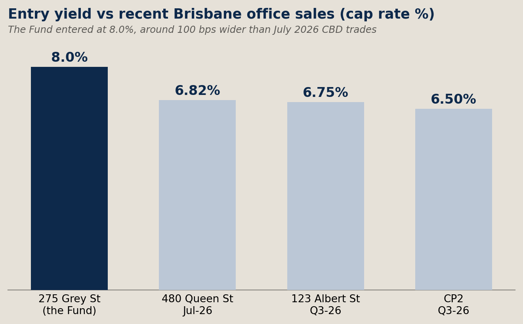
The LDR Grey Street Fund owns 275 Grey Street (Southpoint), a premium office tower on Brisbane’s South Bank that is fully leased and anchored by the ASX 200-listed headquarters of Flight Centre and Virgin Australia. LDR Capital acquired it for $212.4m on an 8.0% capitalisation rate, around 100 basis points wider than the sub-7% yields institutions have paid for comparable Brisbane towers this year. Backing its conviction, the fund’s sponsor, the Lederer Group, has invested $35m of its own capital on the same terms as every other investor and is the fund’s largest single holder. A roughly $33m parcel, drawn to settle the deal on time, is now open to wholesale investors ahead of 30 June 2027.
The Asset
The tower sits in Brisbane’s tightest office submarket, where vacancy is just 0.9% and, LDR notes, no new competing supply is in the pipeline. It is one of only four buildings on Grey Street and the only South Bank tower with rail at its door, with leases running an average of 7.7 years. There is embedded upside, too: when Virgin Australia’s lease expires in 2030, LDR estimates its 25% of the building is let around 16% below current market, leaving room to lift rents on renewal.
Structure & Returns
For investors, the headline is income. On LDR’s baseline modelling, the fund targets an 8.6% average annual distribution yield and a 16.5% net IRR over a five-year hold, both upgraded since the Information Memorandum and both net of fees, with a projected return of 1.9 times capital. The fund’s long-leasehold structure adds a notable tax advantage: LDR estimates all of its FY27 and FY28 distributions, and around 73% across the term, will be tax-deferred, with cash paid monthly.